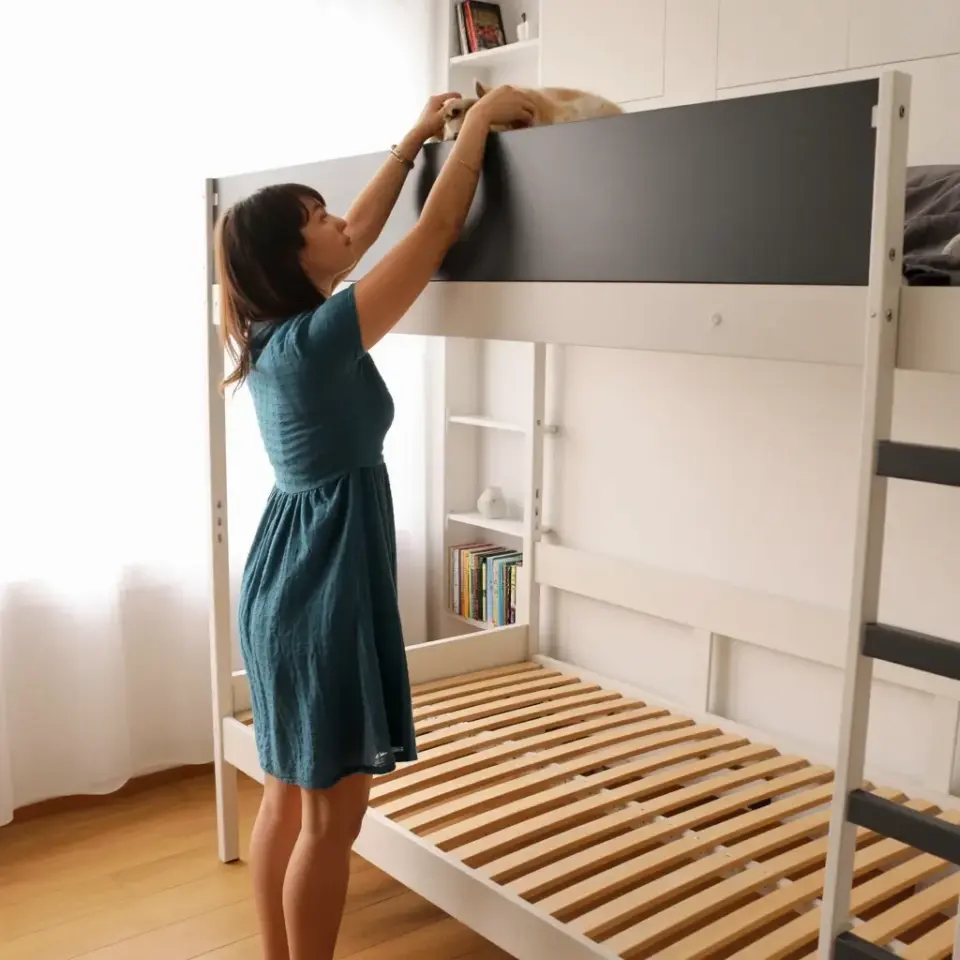
There’s a cat half-hiding under that white bunk bed in the photo, and honestly, that cat is the real design critic. The young woman in the teal dress has to reach up for a book, and the built-in shelving catches the morning light from the left. That’s the kind of bunk bed with built-in shelving that makes a small bedroom work harder without looking crowded. I’ve been staring at this image for a while now, and every time I notice something new, like how the gray headboard softens all that white, or how the slatted wooden base keeps the whole thing feeling airy. So let’s break down exactly how you can recreate this vibe in your own home, one step at a time.
Measure Your Space Before You Fall in Love With a Picture
Look, that photo is gorgeous, but it’s also a very particular room with a very particular ceiling height. Before you buy any bunk bed, grab a tape measure and check three things. The ceiling height matters because you need enough clearance for the top mattress plus a sitting-up person. The floor footprint matters because you still want to open a dresser or a door without playing a game of furniture tetris.
Also measure the wall where you plan to put the bed. The built-in shelving in the photo runs from the side of the bed all the way up to the top, which means the bed itself isn’t a free-standing unit. That’s a custom-looking setup, but you can achieve a similar effect with a standard bunk bed and a separate ladder shelf beside it. So make a rough sketch with dimensions. Write them on a sticky note. Trust me, future you will thank present you.
How Deep Should Your Built-In Shelving Actually Be?
This is where most people mess up. They see shelves like the ones in the photo and assume deeper is better. Nope. The shelving in that picture looks shallow enough to hold books and small decor, but not so deep that you’d lose your phone or keys in the back. For a bunk bed, I’d suggest a depth between 10 and 12 inches. That’s perfect for standard paperbacks, a small plant, or a framed photo.
If you’re building custom shelves, think about the items you actually own. Do you have a stack of thick hardcovers? Then maybe go 12 inches. Are you mostly storing trinkets and a reading lamp? Then 8 inches is plenty. The goal is to keep everything within reach from the bed or the ladder, which is exactly what that woman in the teal dress is doing. She grabs a book without twisting her body awkwardly. That’s the whole point.
Step-by-Step Styling: Make the Shelves Look Lived-In, Not Staged
Here’s a weird thing about me. I hate shelves that look like a store display, where everything is perfectly spaced and color-coordinated to within an inch of its life. The photo gets it right because there’s a mix of objects. Some books are upright, some are stacked flat, and there are a few small decorative pieces hanging out in between. That’s the kind of visual rhythm you want to recreate.
- Stack two or three books horizontally as a mini base, then rest a small plant or candle on top.
- Leave some empty space. Not every inch needs to be filled.
- Put the items you use most at eye level or reachable height, not at the very top.
- Use the top shelf for things you rarely touch, like a special edition or a pretty box.
In the photo, the natural light comes from the left side, which makes the whole shelf glow without extra lamps. If your room doesn’t get that kind of light, consider adding a small LED strip under one of the shelves. Just make sure it’s a warm white. Cool white will make the room feel like a hospital.
Built-In Shelving Meets Daily Life: A Practical Checklist
Daily use is where this setup either shines or falls apart. A bunk bed with shelves is only useful if you can actually reach the shelves from where you sleep. On the bottom bunk, you need a shelf that’s flush with the mattress height or slightly above. On the top bunk, the ladder design determines how easily you can grab things mid-climb.
Here’s what I suggest testing before you commit. Place a book on each shelf and try to grab it while lying down. Can you do it without sitting all the way up? If not, adjust the shelf height. Also consider what you’ll keep on the lowest shelf. In that photo, the cat is hanging out at the bottom, which means there’s open space there. Don’t waste that spot. Use it for a tiny laundry basket or the kid’s bedtime stories.
White Bedroom Storage: Why It Works and What to Avoid
White furniture has a bad reputation for showing every scuff, and people are right to worry. But in a small bedroom, white makes the walls feel like they’re breathing. The bed in the photo uses white for the frame and the shelving, with that gray headboard anchoring it visually. That’s not an accident. Gray adds warmth and contrast, so the white doesn’t become a blank void.
One thing to avoid is all-white everything without any texture. Notice the slatted wooden base under the mattress. It’s not a solid white block. It has visible slats, which adds depth. If you’re buying a ready-made bunk bed, look for one with a similar base or add a woven rug or a textured throw blanket to break up the whiteness. Also, lighter wooden flooring like the one in the photo reflects more daylight, which makes the whole room feel bigger.
Small Bedroom Ideas That Actually Save Space Without Sacrificing Charm
The reason this bunk bed works is that it combines vertical storage with sleeping space in one single piece. You don’t need a separate bookshelf. You don’t need a side table. That’s a huge win for a small bedroom. If you’re working with a narrow room, orient the bed so the shelves face the foot of the bed, not the wall. In the photo, the shelving is visible from a side angle, which tells me it’s integrated into the bed’s structure, not a separate cabinet.
Another space-saving trick is to use the space under the bottom bunk for pull-out drawers. The cat in the photo would probably approve of a cozy hideaway, but for storage, drawers are better. You could also hang a small fabric organizer on the side of the bed for extra odds and ends. Just don’t overdo it. Stick to one or two storage methods, otherwise the room starts to feel like a cargo hold.
The Finishing Touches That Make This Photo Work
Let’s talk about the details everyone misses. The young woman is wearing a short-sleeve teal dress, which suggests it’s a warm day, and the window on the left provides so much natural light that the room barely needs artificial lighting. The cat, a light-colored animal, doesn’t look like it’s hiding. It looks like it owns the place. That’s the energy you want from a bedroom.
When you replicate this, don’t forget to leave some breathing room around the bed. The photo shows a clear path on the floor, which you don’t appreciate until you stub your toe at 2 AM. Keep the floor clean under the bunk, and if you have room, add a small floor basket for throw blankets. That simple addition gives the space a lived-in feel.
Your Turn: Start With One Shelf, Not the Whole Project
I get it, wanting the full Pinterest-worthy makeover is tempting. But here’s a saner way forward. Measure your room, pick one wall, and install a floating shelf beside your existing bed first. Live with it for two weeks. See what you actually put there, and how it affects your daily routine. That little experiment will tell you more than reading a hundred articles about bunk bed storage.
Then, if you’re hooked, invest in the real deal. Look for a solid wood bunk bed with integrated shelving, or adapt an existing one with a ladder shelf unit. Remember the white paint and the gray headboard from the photo, but don’t copy them exactly unless they fit your room’s light. The cat might not care either way, but you will, every single morning when you roll over and see your favorite books neatly within arm’s reach. Go build that space.
Leave a Comment