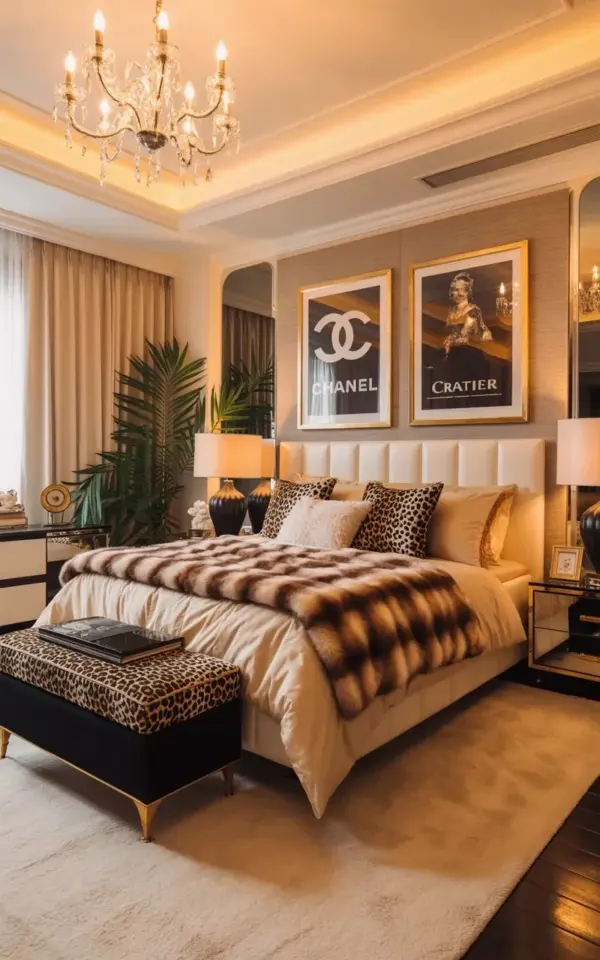
That bedroom in the photo? The one with the cream bedding, the glossy Chanel prints, and the fur throw that looks illegally soft? You can build that exact look for less than the cost of one night at a fancy hotel. I’m serious. The trick isn’t buying expensive things, it’s buying the things expensive people buy and knowing where to get them.
This is a luxury bedroom on a budget, and it’s more about strategy than money. What you see in that picture is a mix of high-low shopping, a few clever art hacks, and textures doing all the heavy lifting. Let me show you how to copy it step by step, without breaking your bank account or your back hauling furniture from three different stores.
Step 1: Start with the Right Wall and Headboard Base
Look at that warm beige wall behind the bed. It’s not accidental. That tone, something between greige and a soft tan, makes everything else look richer. White bedding pops against it, dark wood stands out, and gold frames glow. If your walls are stark white, fix that first.
You don’t need architectural wall panels either, even though the ones in the photo are stunning. I used peel-and-stick wall paneling from Amazon in my last rental and honestly, the landlord asked for the brand. It took me an afternoon and fixed the entire vibe of the room.
The white upholstered headboard is the other anchor. Check Facebook Marketplace or OfferUp before you buy new. These are everywhere for under $100. People sell them when they move and just want them gone. Pro tip: if the fabric is stained, reupholstering with a white linen look-alike from a fabric store costs way less than buying retail.
Step 2: How to Choose Designer Poster Decor That Looks Original
Those black and white posters above the bed are doing something sneaky. One says Chanel, one says Cartier, but they’re not screaming it. They’re subtle, framed, and arranged with breathing room. That’s the trick. Whoever arranged these knew that designer logos look cheap when you crowd them, but look like gallery art when you space them out.
For your own designer poster decor, print quality is everything. Don’t print on flimsy paper. Go to a print shop and ask for heavy matte paper or even canvas. A 16×20 print costs about $8 to print at a local shop, but it looks like a $100 piece once it’s framed properly.
Here’s my favorite hack. Buy the frames first, then shop for the art. When you have the frames sitting on the floor, you know exactly what size your prints need to be. This forces you to be intentional instead of grabbing random posters and hoping they’ll match.
And please, skip the brand name versions of these prints from Etsy sellers charging $40 for a downloadable file. Find the classic advertising posters or search for vintage perfume ads from the 1980s. They’re often public domain now and the design quality is identical.
Step 3: Use a Faux Fur Throw for Texture, Not Warmth
Nobody buys a brown fur throw for warmth. That’s not the point. The point is visual texture, the kind that makes a bed look expensive before you even touch it. The fur throw in this photo is draped flat across the foot of the bed, and that’s the exact placement you should mimic.
Keep it centered and smooth, not bunched up on one side. Folding it into a perfect rectangle and laying it across the bottom third of the bed looks deliberate. It looks like you styled it, even if you just tossed it after making the bed.
For the best budget options, stick to synthetic fibers that don’t shed. You’ll want something that feels heavy, not flimsy. A cheap throw from a discount store feels like a fuzzy blanket. A good faux fur throw has a dense pile and a backing that keeps it from sliding off the mattress all night.
Separate the fur throw from the white bedding. Keep the bedding perfectly smooth and crisp, then let the fur be the only messy element. Contrast is the whole game here.
Step 4: Choose Leopard Print Pillows That Don’t Look Tacky
Leopard can go wrong so fast. The secret is scale and color. Notice how the leopard pillows in the photo use a muted, brown-based print, not a bright orange one. There’s no garish yellow, no harsh black splotches. Just soft, neutral tones that feel like they could be solid brown from across the room.
Get two square accent pillows, around 18 or 20 inches each. Bigger pillows read as modern and calm. Small leopard cushions scream 1998. Textured fabric sells the effect too, like a chenille or velvet leopard print rather than a flat printed cotton.
Here is a quick checklist so you don’t buy the wrong thing:
- Check the base color. Beige or brown, not orange or gold.
- Feel the fabric. It should be nubby or slightly textured, not silky.
- Match the pillow to your throw. They should look like they were bought together, but they don’t need to be identical.
- Place them in front of the fur throw, not behind it. That layering creates depth.
Step 5: Hunt Down a Chandelier or a Realistic Dupe
Ok so this is the splurge in the original photo. That crystal chandelier hanging from the tray ceiling is probably the most expensive single item in the room. And you don’t need that exact one. You need a chandelier that catches light and throws sparkle patterns on the walls.
I found a similar crystal one at a Habitat for Humanity ReStore for $35. It needed rewiring and a new chain, which cost me another $20. But you can also buy brand new ones online for under $150 and they look nearly identical. Look for real glass crystals, even if they’re smaller, rather than plastic that yellows over time.
The tray ceiling helps. If your ceiling is flat, don’t panic. A smaller chandelier that hangs lower creates the same focal point. You just want something that makes people look up when they walk into the room. That upward glance is what sells the luxury feeling.
Installation is the annoying part. Hate to break it to you, but electrical work isn’t a beginner’s DIY project. It’s worth the $100 to hire an electrician who will actually turn off the breaker and not die. But once it’s up, you’ll never regret it.
Step 6: Style the In-Between Areas with a Plant
That large palm plant in a dark container isn’t decoration. It’s a structural move. It fills an empty corner, adds height, and softens all the straight lines of the bed and frames. If you have a plant that actually thrives in that corner, great. If not, get a high-quality fake one.
The fake ones have gotten scary good. I have a fiddle leaf fig tree that requires zero water and guests always touch it to check if it’s real. A plant pot with an interesting shape, matte black or concrete texture, makes the whole plant read as expensive.
Make sure the plant is at least as tall as the headboard. A small sad plant in a corner just draws attention to the empty space above it. Go big or skip it entirely.
What Makes This Style Work is Repetition
Look at how many times the color brown appears in this room. The throw, the leopard pillows, the plant container, the gold accents in the frames. That repetition creates a visual rhythm. Your budget bedroom needs that same through-line, a color you repeat three or four times.
Pick your neutral first. Cream, beige, warm gray, whatever. Then add brown and gold as accents. Stick to that palette for every item you bring in. Track lighting, a bench at the foot of the bed, even a bookshelf in the corner, they should all stay in that family of colors.
Beige is having a moment that isn’t ending anytime soon because it simply works. It’s the comfort food of interior design, familiar and warm and impossible to get wrong. Lean into it.
The final piece is the bedding itself. You need layers of cream and white, but they can be budget pieces. A white duvet insert with a removable cover, a quilt folded at the foot, and a pair of standard pillows in the back will do. Add two euro shams in a slightly darker beige and your bed will look like a catalog photo.
Also, wash everything before you style it. Fluffed pillows and soft fabric just photograph better. Nothing looks more budget than a bed that looks like it came straight out of a plastic package.
Alright, that’s the whole plan. Start with the wall color, grab a headboard, print your designer posters, and layer in that fur throw until your bed looks like a cloud. Pin this post for your next bedroom makeover and then go raid Facebook Marketplace while the good stuff is still available.
Leave a Comment