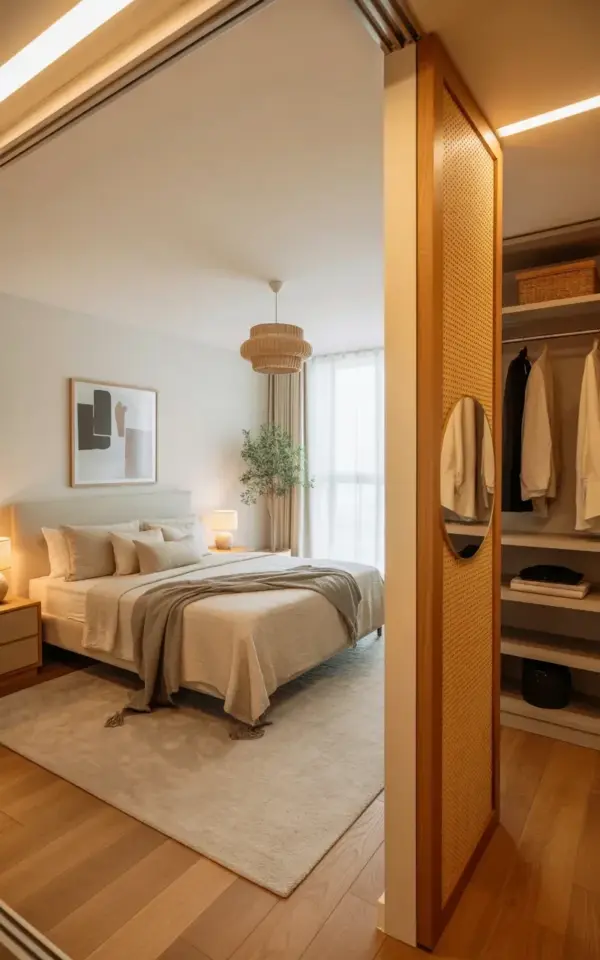
Okay, let’s talk about the actual room in this photo. Beige bedding, a gray throw, a white upholstered headboard, and one very calm olive tree near a sheer curtained window. That’s the whole palette. It’s a minimalist bedroom that somehow manages to feel like a hug in the middle of January. But I’ve also walked into a dozen rooms that tried this exact formula and ended up looking like a storage unit for off-white fabric. The difference isn’t money. It’s avoiding a handful of common mistakes.
Mistake #1: Treating Minimalism as Just Less Stuff
Minimalism gets dragged into rooms that are simply underfurnished. People throw a mattress on the floor, hang one piece of art, and call it a day. That’s not minimalism, that’s a dorm room with a design degree. The real goal is to keep only what earns its place, then give each piece room to breathe. In this photo, the bed is the anchor. The walk-in closet is hidden or integrated, not screaming for attention. Every object has a job. If you look around and see nothing that actually serves the way you live, you’ve removed too much. Start with the essentials, then subtract what’s noisy, not what’s useful.
Mistake #2: Forgetting the Walk-In Closet Needs Its Own Light
A walk-in closet sounds luxurious, but it can become a black hole of wrinkled shirts and lost shoes if you don’t light it right. This is a mistake I see all the time. People spend a fortune on built-in shelving, then rely on the same dim ceiling fixture that barely reaches the corner. Look, your closet is not a cave. It needs its own warm light, not a spotlight, something like a small pendant or a strip of LED under the shelves. And here’s the thing: if your closet does double duty as a dressing area, you need to see colors clearly. That means a neutral bulb, not those harsh blue daylight LEDs that make your skin look like a cadaver.
Mistake #3: Choosing the Wrong White for Winter
You think white is white. Then you paint a wall and spend weeks wondering why the room feels cold. White has a color temperature, and a winter bedroom wants something on the warm side. The wall in this photo is a warm white, soft enough to make the beige bedding and gray throw look intentional. If you pick a stark white with blue undertones, your carefully chosen neutral palette will read as dingy and sad. Test samples in the actual room before committing. And don’t just paint one coat. The first coat always looks patchy and terrifying. Give it a second coat, then turn off your overhead light and look at it in the morning with natural light before judging.
Mistake #4: Layering Textures Without Contrast
Beige on beige sounds boring, but this bedroom pulls it off because of texture. The bedding is slightly rumpled linen or cotton, the throw is that soft gray knit, the headboard is upholstered so it adds a padded, matte surface. Without contrast, it all blurs into a bland mush. The easiest way to fix this is to mix three textures, but make them uneven. A smooth cotton sheet, a chunky knit throw, and a velvet pillow, for example. Here’s a quick checklist for a neutral bedroom that actually feels cozy:
- One matte surface (the headboard, the wall)
- One woven or nubby layer (the throw, a wool blanket)
- One glossy or smooth accent (a ceramic vase, a satin pillowcase)
- One living element (olive tree, any plant)
That’s it. You don’t need five different rug textures and a macrame wall hanging. Let the eye land on a few materials and then rest.
Mistake #5: Letting the Abstract Art Float Away
That black and white abstract artwork over the headboard. It’s not accidental. In a minimalist bedroom, art is the only place your eye can go for interest, so it has to sit at the right height and scale. People either hang it too high or too small. I once saw a tiny 8×10 over a king bed. It looked like a postage stamp on a refrigerator. The art should take up about two-thirds of the width of the headboard, and the center of the frame should be at eye level when you’re sitting up in bed, not standing. Also, don’t clutter the top of the dresser with five little frames. Pick one piece, give it space.
Mistake #6: Killing the Cozy Factor With a Single Light Source
Cozy bedrooms don’t have one light source. They have a main light, a warm lamp, and maybe a candle. In the photo, there’s a woven pendant light and sheer curtains let in a low winter glow. If you only have an overhead fan light, you can’t call it a cozy bedroom. Seriously. Overhead lights are for finding your keys, not for unwinding. Get a bedside lamp with a soft white bulb, or a dimmer on the main switch. Put it on a timer if you’re the kind of person who forgets to turn things off. The goal is to make the room feel smaller and warmer as the sun goes down, and that only happens with layers of light.
Mistake #7: Overlooking the Real Plant Advantage
Here’s the mistake: you buy an olive tree, stick it in a dark corner, and wonder why it drops leaves like a confetti cannon. That plant in the photo isn’t just a prop. It’s a sign of life in a winter room, but it needs real light, preferably by that big window. If you don’t have bright indirect light, don’t
Leave a Comment